Why Unity Is the Most Popular Game Engine for Cross-Platform Development
When it comes to building games that work seamlessly across mobile, desktop, console, and immersive platforms, one engine consistently leads the conversation: Unity. With over 11,500 companies worldwide relying on it for game development and a market share that powers roughly 51% of all games released on Steam, Unity has earned its position not through marketing, but through consistent delivery.
But popularity alone doesn’t make an engine the right choice for every project. In this blog, we’ll break down exactly what makes Unity the dominant force in cross-platform game development, where it excels, where its competitors hold advantages, and how to determine whether it’s the right fit for your project.
Unity by the Numbers: Why Developers Keep Choosing It
Before diving into features, the data tells a compelling story. According to industry reports, 38% of game developers who use game engines choose Unity as their primary platform—more than double Unreal Engine’s 15%. When you look at mobile specifically, the gap widens further: 71% of the top 1,000 mobile games are built on Unity.
The numbers extend beyond gaming. Unity powers approximately 60% of all AR/VR content globally and supports over 25 platforms—from iOS and Android to PlayStation, Xbox, Nintendo Switch, Meta Quest, HoloLens, and WebGL. For businesses seeking maximum reach from a single codebase, this breadth of deployment is difficult to match.
The game engine market itself is projected to grow from $3.2 billion in 2024 to $13.8 billion by 2034. Unity’s position at the centre of this growth—across gaming, automotive, architecture, film, and enterprise applications—makes it far more than just a game engine.
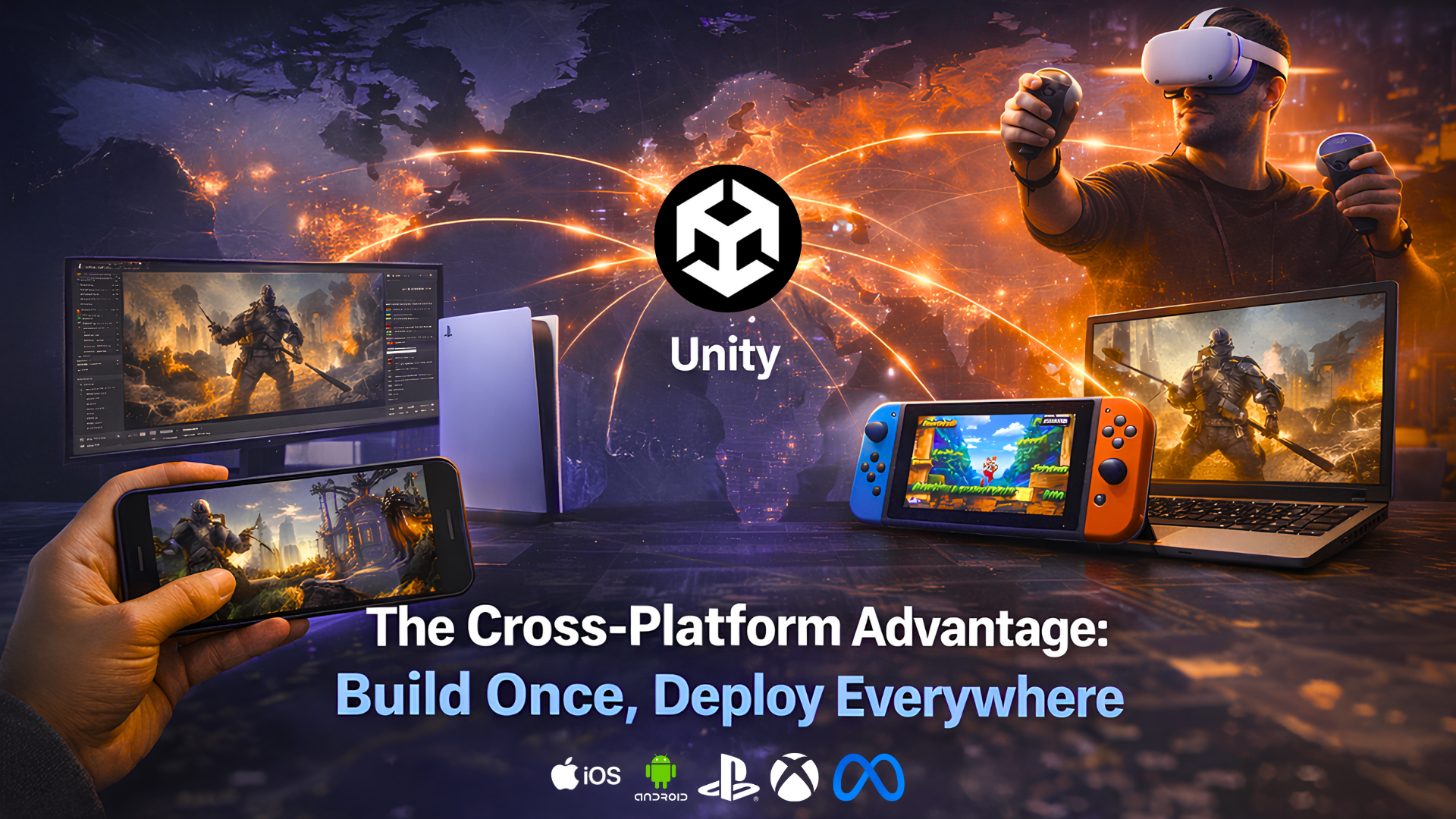
The Cross-Platform Advantage: Build Once, Deploy Everywhere
Unity’s core proposition has always been straightforward: write your code once and deploy it across every major platform without rebuilding from scratch. In 2026, this isn’t just a convenience—it’s a business requirement.
Players now expect to start a session on their phone during a commute, continue on their laptop at home, and pick it up on a console at the weekend. Games that restrict players to single devices feel outdated, regardless of gameplay quality.
Unity handles this through a unified development environment where platform-specific adjustments—input methods, screen scaling, performance optimisation—are managed through configuration rather than separate codebases. The practical benefits are significant:
Reduced Development Costs: A single team maintains one codebase instead of multiple platform-specific versions, cutting both development and maintenance overhead.
Faster Time to Market: Deploying to additional platforms becomes an incremental effort rather than a separate project.
Wider Audience Reach: A single title can target mobile, PC, console, and web simultaneously, maximising revenue potential.
Consistent Quality: Shared logic ensures the core experience remains identical across devices, with platform-specific optimisations layered on top.
Where Unity Truly Excels
Mobile Game Development
Mobile gaming generated approximately $92 billion in 2024—nearly half of total gaming revenue globally. Unity dominates this segment with good reason. Its lightweight runtime, efficient asset pipeline, and mature mobile tooling make it the default choice for studios building on iOS and Android.
Titles like Monument Valley, Among Us, and Candy Crush showcase Unity’s versatility—from artistic puzzle experiences to social phenomenon games to hyper-casual hits. Unity’s ad mediation tools and in-app purchase integration further simplify mobile monetisation.
AR/VR and Immersive Experiences
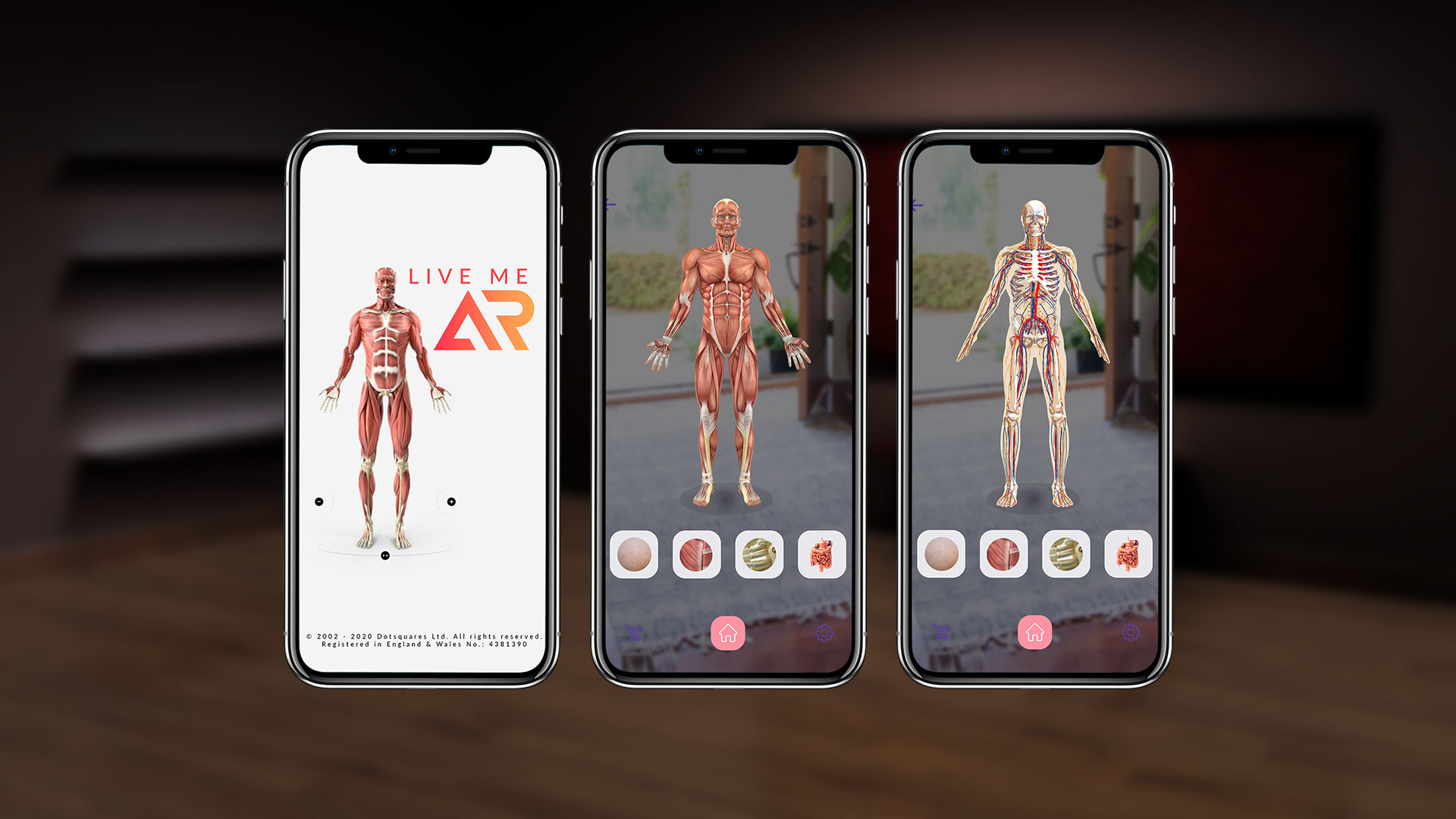
With 60% of AR/VR content built on Unity, it’s the undisputed leader in immersive development. Unity’s XR Interaction Toolkit, ARKit and ARCore integration, and native support for Meta Quest, PlayStation VR2, and HoloLens make it the practical choice for studios entering the immersive space.
Beat Saber—arguably the most commercially successful VR game ever made—was built with Unity. Beyond gaming, enterprises use Unity for training simulations, architectural visualisation, and digital twins, demonstrating the engine’s reach far beyond entertainment.
2D Game Development
Whilst Unreal Engine focuses heavily on 3D graphical fidelity, Unity maintains a dedicated and mature 2D development pipeline. Its Tilemap system, 2D Physics, Sprite Editor, and 2D Animation tools provide a purpose-built environment that doesn’t force 2D developers into 3D workflows. For studios creating platformers, puzzle games, visual novels, or hybrid 2D/3D experiences, Unity offers a more natural fit.
Indie Studios and Small-to-Medium Teams
Unity’s free tier for studios earning under $200,000 annually, combined with its gentler learning curve and extensive documentation, makes it the most accessible professional game engine available. The Unity Asset Store further accelerates development with thousands of ready-made assets, scripts, plugins, and templates—allowing smaller teams to achieve production quality without enterprise budgets.
Unity vs. Unreal Engine: An Honest Comparison
No discussion about Unity is complete without addressing Unreal Engine. Both are excellent tools, and the “best” choice depends entirely on your project’s requirements. Here’s where each engine holds genuine advantages:
| Factor | Unity | Unreal Engine |
| Best For | Mobile, AR/VR, 2D, indie, cross-platform | AAA titles, cinematic visuals, large-scale 3D |
| Platform Support | 25+ platforms from single codebase | Strong but fewer than Unity |
| Graphics | Good to excellent (improving with URP/HDRP) | Industry-leading visual fidelity |
| Learning Curve | Moderate – C# scripting, extensive docs | Steeper – C++/Blueprints, complex toolset |
| Mobile Performance | Excellent – optimised runtime | Improving but heavier footprint |
| AR/VR Support | 60% of all AR/VR content | Growing but smaller market share |
| Asset Ecosystem | Massive Asset Store with 11,000+ publishers | Marketplace growing, fewer options |
| Cost Model | Free under $200K revenue; tiered pricing | Free until $1M gross revenue; 5% royalty after |
| 2D Development | Dedicated 2D pipeline and tools | Primarily 3D-focused |
| Community Size | Largest game dev community globally | Strong but smaller; AAA-focused |
The Key Takeaway: Unity leads decisively in cross-platform breadth, mobile development, AR/VR, and accessibility. Unreal Engine excels in raw graphical power and AAA-scale productions. For most businesses planning cross-platform projects—especially those involving mobile or immersive technologies—Unity remains the stronger strategic choice.
Beyond Gaming: Unity’s Expanding Role
Unity’s influence now extends well beyond traditional game development. Industries across the board are leveraging its real-time rendering and interactive capabilities:
Automotive: Car configurators, virtual showrooms, and design visualisation tools built in Unity allow customers to explore vehicles in photorealistic 3D before production.
Architecture and Real Estate: Interactive walkthroughs and virtual property tours powered by Unity and WebGL give prospective buyers immersive experiences from their browser.
Healthcare and Education: Medical training simulations, anatomy visualisations, and interactive learning modules leverage Unity’s 3D capabilities for outcomes that traditional media cannot deliver.
Film and Animation: Real-time rendering in Unity enables previsualistion and virtual production workflows that are transforming how content is created.
Unity’s non-gaming toolkit revenue grew 34% year-on-year, confirming that the engine is becoming essential infrastructure across multiple industries—not just entertainment.
What to Consider Before Choosing Unity for Your Project
Unity is an excellent choice for most cross-platform projects, but it’s not universally the best option. Here are the questions you should be asking:
What platforms are you targeting? If your project needs to reach mobile, web, console, and VR from a single codebase, Unity’s 25+ platform support gives it a clear edge.
What’s your visual fidelity requirement? For photorealistic AAA visuals, Unreal Engine still leads. For everything else—including stylised, artistic, and mobile-optimised graphics—Unity delivers excellent results with lighter hardware demands.
What’s your team’s expertise? Unity uses C#, which has a lower entry barrier than Unreal’s C++. If your team is familiar with C# or you’re building a team from scratch, Unity reduces onboarding time.
What’s your budget? Unity’s free tier for sub-$200K studios and its Asset Store ecosystem can dramatically reduce initial development costs compared to building everything from scratch.
Do you need AR/VR capabilities? If immersive technology is part of your roadmap, Unity’s dominance in AR/VR makes it the natural choice with the strongest ecosystem and tooling support.
Build Your Cross-Platform Game with Inventive Studio
Choosing the right engine is only half the battle. Execution is what transforms a good idea into a successful product.
At Inventive Studio, Sister Company of Dotsquares Unity is at the core of what we do. Our team of experienced Unity developers has delivered cross-platform games, AR/VR experiences, WebGL applications, and interactive simulations for clients across the globe. From concept and prototyping through to launch and live operations, we handle the complete development lifecycle.
Whether you’re a startup exploring your first mobile game, an enterprise looking for immersive training solutions, or a publisher seeking a reliable development partner for cross-platform deployment—we have the expertise and track record to deliver.
Explore our Unity development services or get in touch to discuss how we can bring your project to life across every platform that matters.
End Note
Unity’s dominance in cross-platform game development isn’t accidental. It’s the result of two decades of consistent investment in accessibility, platform breadth, and developer experience. Whilst no engine is perfect for every scenario, Unity’s combination of cross-platform reach, mobile excellence, AR/VR leadership, and a thriving ecosystem makes it the most versatile choice available in 2026.
The question for most businesses isn’t whether to use Unity—it’s finding the right team to unlock its full potential. And that’s exactly where we come in. Gaming Trends 2026